Attribution Creative Commons Noncommercial No Derivatives Share Alike Zero

Potplayer Arm64 Hot

The phrase encapsulates a specific moment in Windows history—the transition from inefficient emulation to glorious native speed. While not official, the community-driven ARM64 builds solve the overheating crisis for Windows tablets and laptops.

Hardware-accelerated video playback on ARM64 devices

Here is the secret sauce. While x64 players rely on DXVA, ARM64 GPUs (like the Adreno in Snapdragon) handle decoding differently. For the "Hot" experience: potplayer arm64 hot

Once you have the ARM64 version running, you retain all the classic PotPlayer features that made it famous:

While the player core manages the interface, the rendering engine depends on underlying decoders. The phrase encapsulates a specific moment in Windows

In the world of Windows media players, has long reigned supreme. Praised for its lightning-fast speed, near-universal codec support, and minimalistic yet powerful interface, it has been the go-to VLC alternative for power users. However, the computing landscape is shifting. With the advent of ARM64 architecture—powered by chips like the Snapdragon X Elite and the growing ecosystem of Windows on ARM—a new question has emerged: Is there a PotPlayer ARM64 Hot version, and how does it perform?

The primary reason why "PotPlayer ARM64" remains a hot keyword is the user demand for a dedicated, 100% native build to squeeze out maximum battery efficiency. Thankfully, the x64 version running under Windows 11 emulation is completely stable, ensuring you don't lose access to your favorite media configurations. Key Features Making PotPlayer "Hot" on Modern PCs While x64 players rely on DXVA, ARM64 GPUs

Post a feature request on the Potplayer Reddit , where developers and power users often track high-demand features like native ARM64 compatibility. 2. Optimize Performance on ARM64

: Recent Windows preview updates (notably KB5077241 ) have been known to cause massive startup delays (up to 2 minutes) for PotPlayer. If you encounter this, uninstalling that specific update or switching to the 32-bit player usually resolves it.

A native ARM64 media player addresses these issues by communicating directly with the silicon, maximizing hardware acceleration like Qualcomm's built-in Hexagon NPU or Adreno GPU. Why PotPlayer on ARM64 is a Game Changer
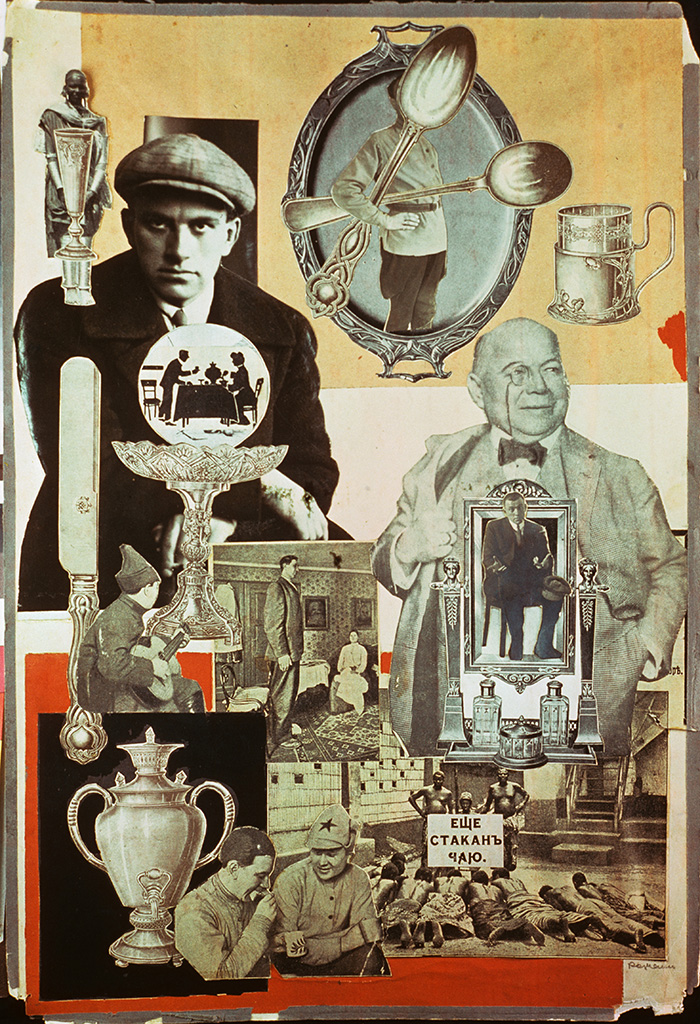
Fig. 1. — Brigade KGK (Viktor Koretsky [1909–98], Vera Gitsevich [1897–1976], and Boris Knoblok [1903–84]). “We had to overcome among the people in charge of trade the unhealthy habit of distributing goods mechanically; we had to put a stop to their indifference to the demand for a greater range of goods and to the requirements of the consumers.” From the 16th to the 17th Congress of the All-Union Communist Party (Bolsheviks), 1934, no. 57, gelatin silver print, 22.7 × 17 cm. Los Angeles, Getty Research Institute, 2014.R.25.
Fig. 2. — Brigade KGK (Viktor Koretsky [1909–98], Vera Gitsevich [1897–1976], and Boris Knoblok [1903–84]). “There is still among a section of Communists a supercilious, disdainful attitude toward trade in general, and toward Soviet trade in particular. These Communists, so-called, look upon Soviet trade as a matter of secondary importance, not worth bothering about.” From the 16th to the 17th Congress of the All-Union Communist Party (Bolsheviks), 1934, no. 56, gelatin silver print, 22.7 × 17 cm. Los Angeles, Getty Research Institute, 2014.R.25.
Collage of photographs showing Vladimir Mayakovsky surrounded by a silver samovar, cutlery, and trays; two soldiers enjoying tea; a giant man in a bourgeois parlor; and nine African men lying prostrate before three others who hold a sign that reads, in Cyrillic letters, “Another cup of tea.”
Fig. 3. — Aleksandr Rodchenko (Russian, 1890–1956). Draft illustration for Vladimir Mayakovsky’s poem “Pro eto,” accompanied by the lines “And the century stands / Unwhipped / the mare of byt won’t budge,” 1923, cut-and-pasted printed papers and gelatin silver photographs, 42.5 × 32.5 cm. Moscow, State Mayakovsky Museum. Art © 2024 Estate of Alexander Rodchenko / UPRAVIS, Moscow / ARS, NY. Photo: Art Resource.
Fig. 4. — Boris Klinch (Russian, 1892–1946). “Krovovaia sobaka,” Noske (“The bloody dog,” Noske), photomontage, 1932. From Proletarskoe foto, no. 11 (1932): 29. Los Angeles, Getty Research Institute, 85-S956.
Fig. 5. — Brigade KGK (Viktor Koretsky [1909–98], Vera Gitsevich [1897–1976], and Boris Knoblok [1903–84]). “We have smashed the enemies of the Party, the opportunists of all shades, the nationalist deviators of all kinds. But remnants of their ideology still live in the minds of individual members of the Party, and not infrequently they find expression.” From the 16th to the 17th Congress of the All-Union Communist Party (Bolsheviks), 1934, no. 62, gelatin silver print, 22.7 × 17 cm. Los Angeles, Getty Research Institute, 2014.R.25.
Fig. 6. — Brigade KGK (Viktor Koretsky [1909–98], Vera Gitsevich [1897–1976], and Boris Knoblok [1903–84]). “There are two other types of executive who retard our work, hinder our work, and hold up our advance. . . . People who have become bigwigs, who consider that Party decisions and Soviet laws are not written for them, but for fools. . . . And . . . honest windbags (laughter), people who are honest and loyal to Soviet power, but who are incapable of leadership, incapable of organizing anything.” From the 16th to the 17th Congress of the All-Union Communist Party (Bolsheviks), 1934, no. 70, gelatin silver print, 22.7 × 17 cm. Los Angeles, Getty Research Institute, 2014.R.25.
Fig. 7. — Artist unknown. “The Social Democrat Grzesinski,” from Proletarskoe foto, no. 3 (1932): 7. Los Angeles, Getty Research Institute, 85-S956.
Fig. 8A. — Pavel Petrov-Bytov (Russian, 1895–1960), director. Screen capture from the film Cain and Artem, 1929. Image courtesy University of California, Berkeley, Berkeley Art Museum and Pacific Film Archive Library.
Fig. 8B. — Pavel Petrov-Bytov (Russian, 1895–1960), director. Screen capture from the film Cain and Artem, 1929. Image courtesy University of California, Berkeley, Berkeley Art Museum and Pacific Film Archive Library.
Fig. 8C. — Pavel Petrov-Bytov (Russian, 1895–1960), director. Screen capture from the film Cain and Artem, 1929. Image courtesy University of California, Berkeley, Berkeley Art Museum and Pacific Film Archive Library.
Fig. 9. — Herbert George Ponting (English, 1870–1935). Camera Caricature, ca. 1927, gelatin silver prints mounted on card, 49.5 × 35.6 cm (grid). London, Victoria and Albert Museum, RPS.3336–2018. Image © Royal Photographic Society Collection / Victoria and Albert Museum, London.
Fig. 10. — Aleksandr Zhitomirsky (Russian, 1907–93). “There are lucky devils and unlucky ones,” cover of Front-Illustrierte, no. 10, April 1943. Prague, Ne Boltai! Collection. Art © Vladimir Zhitomirsky.
of